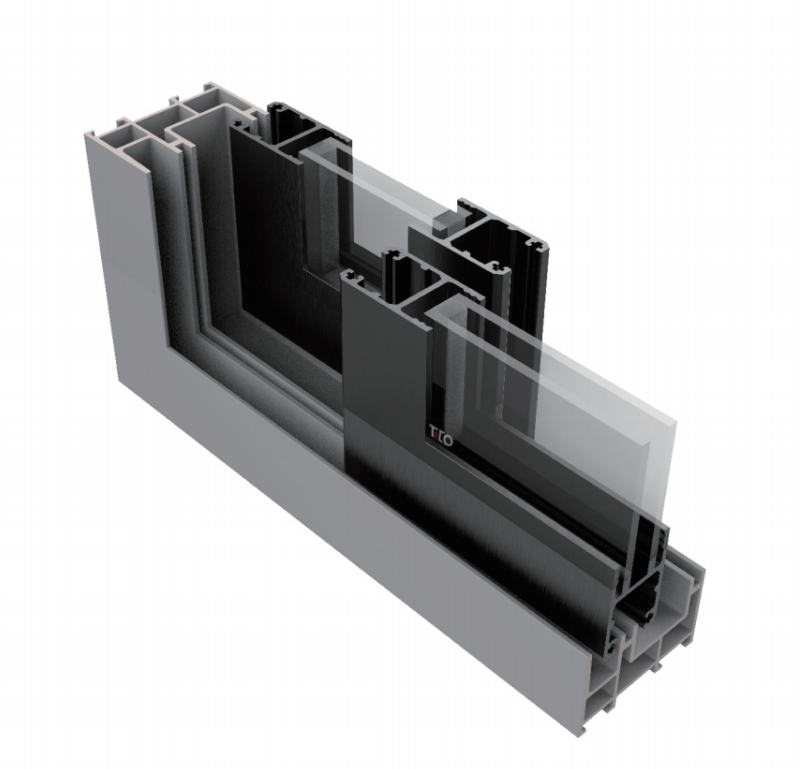
GFRPU · PULTRUDED FIBERGLASS REINFORCED POLYURETHANE PROFILESGrade 7 Wind resistance | Grade 5 Watertightness | Grade 8 Air permeability | Grade 4 Acoustic insulation |
GFRPU profile Casement window Top-hung window Casement + top-hung combo Fire-rated performance Triple glazing compatible Passive house ready PU-GF composite profileFiberglass window profiles Pultruded composite profiles FRP window frames Polyurethane composite window Thermal break-free profiles Low carbon window frames≥1200 MPa Flexural strength — 5× aluminium | 0.34 W/m·K Thermal conductivity — no break needed | >1100 °C Fire failure temp — vs 680 °C aluminium | 1/8 Carbon emissions vs aluminium |
GFRPU profile Casement window Top-hung window Casement + top-hung combo Fire-rated performance Triple glazing compatible Passive house ready PU-GF composite profileNaturally fire-resistant — no additives neededGlass fibre forms an inorganic char barrier on combustion. Fire integrity 0.5–1.5 h. Failure temp >1100 °C vs 680 °C for aluminium. | Zero thermal bridging — inherent to the material0.34 W/m·K conductivity eliminates thermal break strips. Whole-window K-value down to 1.3 W/(m²·K). |
Low embodied carbon — 1/8 of aluminiumManufacturing emissions at 1/8 of equivalent aluminium. Supports LEED, BREEAM and net-zero targets. | ≥35 dB acoustic insulationNon-metallic non-homogeneous structure for airports, elevated roads, and dense urban environments. |
Property | Aluminium alloy | GFRPU composite | Nylon thermal strip | PVC / UPVC | Regular FRP |
Density (g/cm³) | 2.79 | 2.1 | 1.3 | 1.5 | 1.9 |
Thermal conductivity (W/m·K) | 160 | 0.34 | 0.30 | 0.35 | 0.45 |
Flexural strength (MPa) | 250 | ≥1200 | 80–180 | 30 | 300–400 |
Flexural modulus (GPa) | 50–80 | 41.3 | 2–5 | 2.2–5 | 10–22 |
Dimensional shrinkage (≤%) | 0.6 | 0.2 | 0.4 | 0.4 | 2.0 |
Linear expansion (×10⁻⁵ K⁻¹) | 2.2–2.4 | 0.5–0.8 | 2.4–3.5 | 5–8.5 | 0.73 |
Fire failure temp (°C) | ~680 | >1100 | — | ~280 | — |
Natural fire resistanceFailure temp >1100 °C. Burns to carbon char that self-limits flame spread. Fire integrity 0.5–1.5 h without additives or coatings. | Zero thermal bridgingConductivity 0.34 W/m·K — 470× lower than aluminium. No break strip required. Whole-window K-value as low as 1.3 W/(m²·K). | Dimensional stabilityLinear expansion 0.5–0.8 × 10⁻⁵ K⁻¹, closely matching concrete. Eliminates cracking and air-leakage at frame-to-wall junctions. |
Superior acoustic performance≥40 dB sound reduction. Non-homogeneous non-metallic structure — ideal for flight paths, elevated roads, and dense urban areas. | Low embodied carbonManufacturing emissions just 1/8 of equivalent aluminium profiles. Supports LEED, BREEAM, and net-zero building targets. | Corrosion and UV resistantImpervious to saltwater and pollutants. Coating weatherability ~1.5× powder-coated aluminium. Ideal for coastal applications. |
High-grade dimensional tolerances1 m straightness ≤0.25 mm (vs 0.40 mm benchmark). 3 m deviation ≤2 mm. Perpendicularity ≤0.4%. Equivalent to aluminium high-precision extrusion standards. | Ultra-low shrinkage — long-term stabilityShrinkage ≤0.2%. Across a 40 °C swing, deformation is only 0.15 mm — vs 5 mm for UPVC and 1 mm for aluminium. Profiles stay true over decades. |
Proprietary surface coating — multi-finish, long lifeAdhesion ≥Grade 1. After 6,000 h ageing, colour shift ΔE ≤5. Gloss, matte, and textured finishes available. Weathering life ~1.5× powder-coated aluminium. | Project-specific formulationGlass fibre 70–82%, polyurethane and additives 18–30%. Adjustable to project requirements for strength, weight, or fire performance. |